Terracotta army, Great Wall and Grand Canal in a city builder
Monuments are the slow heart of a city builder: you plan around them for years and watch them rise stage by stage. Glyph Dynasty has six. Three of them are among the most famous constructions of ancient China: the Great Wall, the Grand Canal and the Mausoleum of the First Sovereign with its terracotta army. Here is how each is built in the game, and what history says about the real one.
How monuments are built
No monument appears by clicking. You need a builders’ yard, which sends out builders and haulers, and storage holding the right materials: timber, stone, clay, pottery, bronze. Haulers carry them to the site, and the monument goes through its stages one by one. The six monuments are the Great Wall, the Grand Canal, a royal tomb, the Hall of Light, the Mausoleum of the First Sovereign and the Weiyang Palace.
The Great Wall
In the game the Great Wall is dragged out section by section and rises in three stages: a rampart of rammed earth, stone facing, then battlements and a walkway. A finished wall weakens raids and pleases the court. Sections join at corners and meet rivers cleanly.
The real history is longer than one wall. States of the Warring States period built their own frontier walls, mostly of rammed earth; after unification the Qin linked and extended them, and the Han pushed walls and watchtowers far to the west, towards the Jade Gate. The brick and stone wall most people picture, with its towers on mountain ridges, is largely the work of the much later Ming dynasty. The game’s stone facing is a nod to that image; its first stage is the older truth.
The Grand Canal
A canal is dug from the water outward in three stages: digging the bed, lining the banks, letting the water in. A finished canal irrigates fields within two tiles and becomes a route for trading ships. A trade quay can stand on the canal if ships can reach the edge of the map through it and the river; demolish a section and the ships look for another way or turn back.
Historically, Chinese canal building began early: the state of Wu dug a canal linking the Yangtze and the Huai in the fifth century BC, in the Zhou period, which is where the canal appears in our campaign. The Grand Canal as a single waterway from the north to Hangzhou was joined together under the Sui dynasty around AD 600, long after the Han. The name in the game is a liberty; the stages are honest.
The Mausoleum and the terracotta army
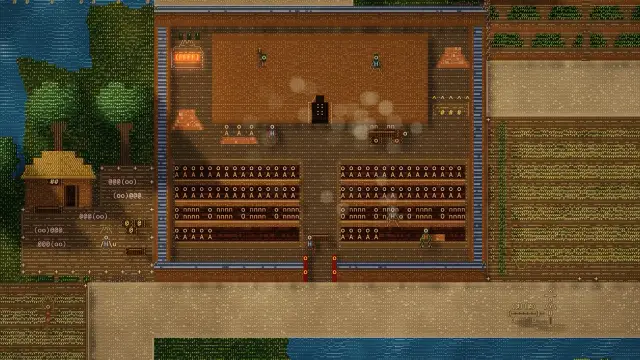
The Mausoleum of the First Sovereign is a Qin monument, 5×5 tiles, one per city. It rises in four stages: the enclosure and mound of stone and clay, the underground palace of timber and bronze, the clay army of pottery with weapons and horses, and the burial mound. During the clay army stage the pits fill row by row. An edict of corvée labour speeds the builders but takes workers and contentment while it lasts.
The real army was found in 1974 by farmers digging a well near Xi’an. The pits hold thousands of life-size figures of fired clay, each face different, originally painted and armed with real bronze weapons, along with horses and chariots. The burial mound itself has never been opened. In the game the soldiers carry real weapons and the horses stand beside them, because that is what makes the real army astonishing.
The other three
The royal tomb of the Shang rises from underground chambers through a stone vault and a clay guard to a mound and stele. The Hall of Light of the Zhou is a ritual hall on a stone platform. The Weiyang Palace of the Han, finished with gardens and chambers of jade and silk, is the goal of free play. In online co-op there are three more monuments that no one can build alone. For the periods behind all of them, read five dynasties from Xia to Han.
Glyph Dynasty is coming to Steam for Windows, macOS and Linux. Watch the clips, follow the development history or open the press kit.