Chinese history strategy game: five dynasties from Xia to Han
The campaign of Glyph Dynasty runs through five dynasties, from the legendary Xia to the Han. That is roughly two thousand years of Chinese history, from the first bronze-age settlements to an empire that traded along the Silk Road. Here is what is known about each period, and how the game turns it into a city.
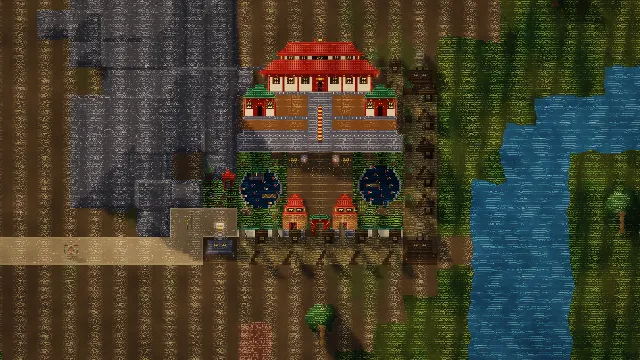
Xia, about 2070–1600 BC
The Xia are the first dynasty of the traditional histories, and the hardest to pin down. No writing from the period has been found, and historians still debate how the Xia relate to the archaeological Erlitou culture in the Yellow River valley. The founding story is about water: Yu the Great is said to have tamed the floods by digging channels rather than building ever higher walls.
In the game, the Xia are the beginning: huts on the high road, millet on the floodplain, a first granary, potters and the river that must be held back with dykes. The four Xia missions introduce the basics of a walker-based city builder one at a time, and in co-op the Xia monument is the Dykes of Yu the Great.
Shang, about 1600–1046 BC
With the Shang, China enters written history. Their kings asked questions of their ancestors by cracking bones and turtle shells and carving the answers on them: these oracle bones are the earliest mature Chinese writing. Shang bronze casting reached a level that still astonishes, and the last Shang capital, near modern Anyang, is one of the great sites of Chinese archaeology.
The game’s Shang missions add trade and royal tombs. The ruler of the Shang is a king, 王, and the tomb is a royal tomb, 王陵: we keep the titles of the period rather than later ones.
Zhou, 1046–256 BC
The Zhou overthrew the Shang and explained it with the Mandate of Heaven: the right to rule comes from Heaven and is lost by misrule. The Zhou are the longest dynasty in Chinese history, but for most of it their kings ruled in name only, while rival states fought through the Spring and Autumn and the Warring States periods. Confucius lived in this age. Later writers described an ideal well-field system, with land divided into nine squares like the character 井.
In the game, the Zhou bring the court: requests, gifts and the favour of the Son of Heaven, the Mandate of Heaven as a mission, the Hall of Light for rites, and a canal to water the well fields.
Qin, 221–207 BC
The Qin state conquered its rivals and united China in 221 BC. Its ruler, known as the First Sovereign of Qin, standardised weights and measures, coinage, writing and even the width of cart axles, built roads and linked earlier frontier walls. His mausoleum near Xi’an, with its army of fired clay, is one of the most famous archaeological sites in the world. The dynasty itself barely outlived him.
The Qin missions are about unification: the edict of uniform measures, law officers sent to every house, paved roads, coins struck at the mint, and the Mausoleum of the First Sovereign with its clay army, the subject of a separate article.
Han, 206 BC – AD 220
The Han kept much of the Qin state and softened its laws. Their capital Chang’an grew around the Weiyang Palace. Envoys went west, the Jade Gate opened the road towards Central Asia, and the Han fought for the "heavenly horses" of Dayuan in the Ferghana valley. The court argued over the state monopoly on salt and iron and founded the Taixue, an academy for Confucian learning. Paper came into use.
The four Han missions end the campaign: the Jade Gate and the Silk Road, glass and heavenly horses from Dayuan, the Salt and Iron Office, the Taixue, a cavalry camp and the Weiyang Palace, without which there is no Mandate in free play.
Where the game takes liberties
Glyph Dynasty is a city builder, not a textbook. Building chains are simplified, epochs are compressed, and some monuments are placed generously: the Grand Canal as a single waterway belongs to the later Sui dynasty, though canal building in China goes back to the Zhou. Where we can, we use the words of the period, such as 粟 for millet and 明堂 for the Hall of Light; in every language the ruler is the Son of Heaven. The full campaign is described on the home page, and how it came together is in the development history.
Glyph Dynasty is coming to Steam for Windows, macOS and Linux. Watch the clips, follow the development history or open the press kit.