League of Cities: an online co-op city builder for 2–4 players
On 22 October 2026 the online mode of Glyph Dynasty got its goals: League of Cities, a co-op for 2–4 players with a shared monument, the First to Rise race, and a free game without an end. It is still in development and not yet in the game, but its shape is settled, and this is how it works.
A city each, one world map
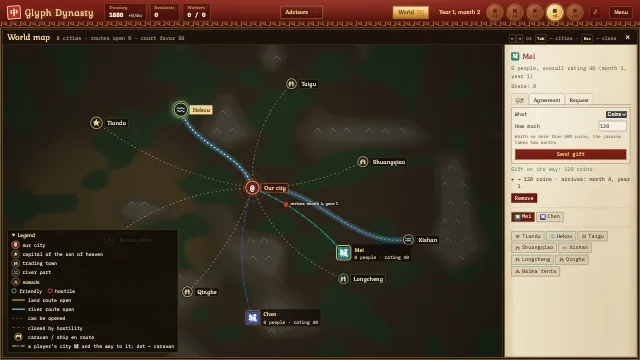
Most city builders are solitary, and for good reason: a city is a slow, personal thing. So in Glyph Dynasty co-op every player still builds a city of their own, on their own map, at their own pace. The cities meet on the world map, each marked with the character 城 ("city") in its player’s seal colour, with its population and ratings next to it.
From there you can send a neighbour coins or goods by caravan, agree a trade pact, under which the seller ships goods every three months and the buyer pays on arrival, or ask for help when a flood or a raid hits. Caravans travel in real game time, so a gift sent in spring arrives some months later, with its arrival shown on the map.
The shared monument
The League of Cities goal is a monument that all players build together. Which one depends on the starting epoch: the Dykes of Yu the Great when the game starts in the Xia, the Round Altar of Heaven from the Shang, Zhou or Qin, and the Nine Tripod Cauldrons when all epochs are open. Everyone contributes coins, goods and food, but the caravan to the monument takes no more than a player’s share each month. One strong city cannot finish it alone; the league has to grow together, within 16 to 18 game years.
At the end comes a results screen: whether the monument was built, each city’s contribution and share, its residents and ratings, the best city for each rating, and shared achievements such as the first gift, the first pact and the finished monument.
Two more ways to play
- First to Rise: a race in which the first city to meet the goal for the next epoch wins, and places go by the month it got there
- Free play: no end and no winner, results on request
How it stays in sync
Sending whole cities over the network would be slow and fragile. Instead the game relies on the determinism built in on day one: players exchange only their actions and a monthly seal, a short fingerprint of their city. Each month the game waits until every seal has arrived, so everyone sees the same world. If a city ever diverges, the game can replay it and name which part went wrong.
Players who drop out are handled too. A sleeping neighbour keeps receiving gifts, and their pacts pause instead of failing. A returning player gets everything they missed, and their city catches up on the missed months. Even a lost save can be rebuilt from the neighbours’ journals.
Through Steam, with friends
Online play is planned to run through Steam: the host opens a friends-only lobby for 2–4 players and invites friends from their Steam list, and traffic goes through Steam’s relay network. Player names stay on the players’ own machines; saves do not store them. The host chooses the goal, difficulty, speed and starting epoch.
What is next
The full co-op is planned for Early Access, and the roadmap lists races and a daily map before it grows to 5–8 players. The Steam demo will be single-player only. If you want to know how the shared monuments relate to the real ones, read about the Great Wall, the Grand Canal and the terracotta army.
Glyph Dynasty is coming to Steam for Windows, macOS and Linux. Watch the clips, follow the development history or open the press kit.