From 10×5 to 16×8: how our ASCII art grew up
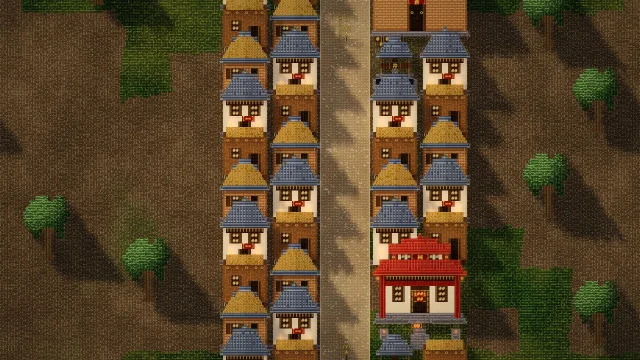
On 20 October 2026 the map of Glyph Dynasty switched to a new grid: each tile became 16 characters wide and 8 tall instead of 10×5. The tile stays the same size on screen; the characters get smaller, and suddenly there is room for windows, shutters, roof tiles and lanterns. The same day the game reached version 0.9.
Why change the grid at all
At 10×5 characters per tile, a house is about fifty characters. That is enough for a roof, a wall and a door, but not much else: every building is a sketch. ASCII art is a craft of choosing what to keep, and at that size almost everything has to go.
At 16×8 a tile holds 128 characters, two and a half times as many, at the same 2:1 shape. A character on screen shrinks by a factor of 1.6, and in the dense style each one is further split into finer marks, so the picture gains detail without the city getting bigger. Now a window can have a frame like [##], a door can have a handle, and a roof can show rows of tiles with upturned corners.
How the pictures were redrawn
Every picture in the game is a pair of lines of equal width: the text itself, and a colour map that says which palette entry each character takes for its glyph and its background. Redrawing all of them at once would have broken the game for days, so the renderer got a fallback: any building without a 16×8 drawing is enlarged automatically from its 10×5 one. New drawings replace the enlarged ones one by one, and the game stays fully playable at every step.
The first batch was thirteen pictures from the "bigger" sample. On the same day came the large set: the Great Wall, the Grand Canal, city walls, gates and towers, the pagoda, the temple, the palace, noble houses, gardens, statues, the quay, a junk and the festival square. Today every building, at every level, stage and orientation, and every walker and soldier has its own 16×8 drawing.
Two grids, one game
The old drawings did not go away. The low graphics setting and the fallback renderer still use 10×5, which keeps the game light on old laptops and on machines without WebGL2. The grid is a parameter of the renderer, not a fork of the art.
What a good 16×8 drawing looks like
- Real details read: windows in a frame, shutters, doors, rows of roof tiles, ridge ends, lanterns, goods on a stall
- Single random letters read as noise, so they are avoided
- The base of a building fills exactly its tiles; roofs, flags and smoke may overhang the tile behind it
- Everything faces the viewer in a 3/4 view, with the roof seen from above
Version 0.9 the same day
Also on 20 October the game reached 0.9.0, the first build with a version number: every core system in one build, ready for playtests. The Chinese title was settled the same day too: 《字里乾坤》, "a whole world within the characters". The full list of what each version brought is on the development history page, and the technique behind the drawings is in how we draw a whole city with text characters.
Glyph Dynasty is coming to Steam for Windows, macOS and Linux. Watch the clips, follow the development history or open the press kit.