Ancient China city builder in text: Glyph Dynasty begins
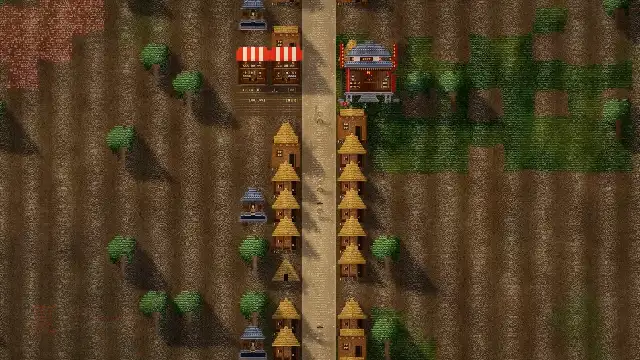
On 19 October 2026 the first commit of Glyph Dynasty landed: a historical city builder set in ancient China, in which the whole map is drawn with text characters. This is what the project set out to be, and what the prototype could already do at the end of that first day.
A city builder in the old tradition
Glyph Dynasty is a walker-based city builder. Nothing in the city works by radius or by magic: a water carrier, a market vendor, a shrine priest and a tax collector each leave their building and walk the streets, and a house receives water, food or a blessing only when the right person passes its door. Lay the streets out well and the houses climb on their own; leave a gap and a quarter quietly falls back.
If that sounds like the city builders of the late nineties, it is meant to. We wrote a separate article on what Glyph Dynasty shares with Pharaoh and Caesar III, and where it goes its own way.
Why ancient China
Ancient China gives a city builder everything it needs: rivers that flood and must be held back with dykes, millet and rice on the floodplain, potters, bronze casters and silk weavers, a court that asks for tribute, and monuments that take generations. The campaign follows five dynasties, from the first settlements of the Xia to the Han capital with its palace and the Silk Road. The history behind that campaign has its own article.
Why text characters
Text graphics are usually a constraint. Here they are the material. Chinese is written with characters, and a city drawn with characters felt like the right way to show it: tiled roofs made of strokes, fields of repeated marks, carts and walkers that are small groups of letters. On the very first day we tried three approaches to drawing them on the GPU, and the one we kept is the dense style: small characters with texture, volume, shadows and night, rendered with WebGL2.
Text graphics are not a filter over a 3D scene. Every building, tree and person is a hand-made picture typed out of characters, and the renderer lays those pictures onto a 3/4 view where roofs overhang the street behind them. How that works is explained in how we draw a whole city with text characters.
What the prototype could do on day one
- An economy of walkers, carters, granaries and warehouses, with houses that rise and fall
- A first campaign of four Xia missions, each with its own map seed, goals and buildings
- Disasters: floods held back by dykes, drought fought with water wheels, plague, locusts and earthquakes, plus fires and collapses in neglected streets
- Faith and culture: shrines to the ancestors, temples and a pagoda, schools, acrobats and theater, and festivals, including the New Year
- A deterministic simulation with its own random number generator, a journal of player actions and a fingerprint of the game state
Why determinism mattered from the start
The last point is invisible to players, but it shaped everything after it. Given the same map seed and the same actions, the game always produces the same city, bit for bit. That makes bugs reproducible, lets a balance bot play hundreds of games overnight, and later made online co-op possible without sending whole cities over the network: players only exchange their actions.
A plan for Steam
The same day the project got a written plan for the road to Steam: a name, a store page, a demo, playtests and then Early Access. Two weeks later much of it is in place, and the current plan lives on the roadmap. The next big step came the following day, when the characters themselves grew from 10×5 to 16×8 per tile.
Glyph Dynasty is coming to Steam for Windows, macOS and Linux. Watch the clips, follow the development history or open the press kit.