32×16: the whole city drawn again, with four times the detail
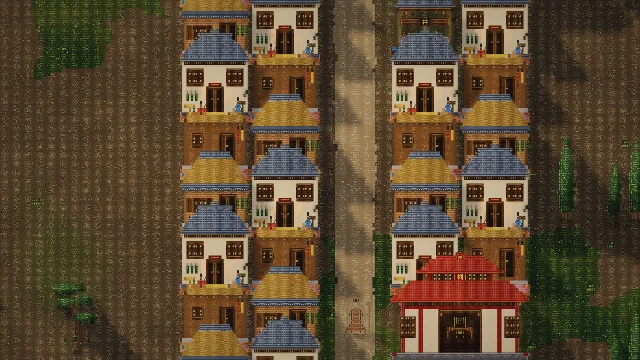
On October 25, 2026 Glyph Dynasty got a new level of detail. Up close, every map tile is now 32 characters wide and 16 tall: 512 characters where 16×8 had 128. Every building of the five dynasties, the ground, the water, the trees and every walker were drawn again for it, and it is all still text.
Why draw everything again
The move from 10×5 to 16×8 gave the city windows, shutters and rows of roof tiles. But zoom in close and a 16×8 drawing simply got bigger: each character turned into a large blot, and the street ran out of detail exactly where players look the longest. So the closest zoom levels got a tile of their own, 32×16, and drawings made for it.
The drawings are real characters, not a picture baked from them. That was the rule from the start, and it means everything that works on text keeps working: daylight and night, the wave of lanterns at dusk, rain and snow, shadows, and Show glyphs and .txt snapshots, which now give the 32×16 characters too.
What was redrawn
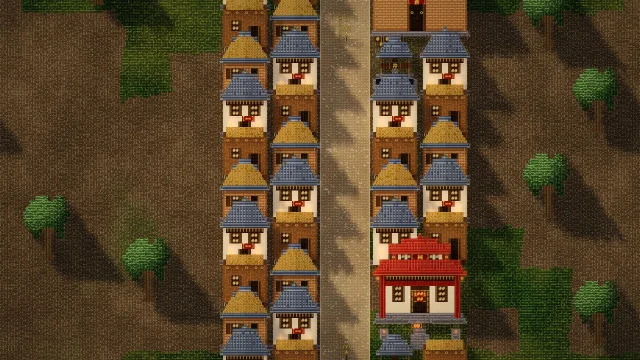
- Every building of all five dynasties, at every level: houses from the first hut to level 10, the nobility up to its sixth step, each epoch drawing its own
- Monuments in every stage of construction: the Great Wall, the Grand Canal, the Hall of Light, the Weiyang Palace and the Mausoleum, whose base alone is 160×80 characters; its pits fill with clay soldiers drawn at full height, with head, armour and legs
- The ground: water, shores, dirt roads and the paved chidao, rocks and the cracks of a drought
- Every walker with a load of their own: a merchant with a carrying pole and baskets, a priest with a censer, a builder with a plank and a hammer, a carter whose cargo takes the colour of the goods, a fire watchman with two buckets. A figure is now ten characters tall, with a face, hands and shoes
- The army: infantry with the ji halberd, crossbowmen, chariots with a pair of horses, raiders with axes and the Han cavalry
- Signboards: the character now sits on a board two rows high, so it reads no smaller than at 16×8
A building without a 32×16 drawing yet would not break the game: its 16×8 drawing is enlarged by the role of each character, not by turning every letter into a 2×2 block. A fill repeats, a line stretches but stays one character thick, and a large mark such as a window or a signboard appears once. The same trick carried the game through the move to 16×8.
Trees for four seasons
Fifteen kinds of trees and woods, four variants each, for every season: a Chinese pine with flat tiers on a crooked trunk, a weeping willow by the water, mulberries by the fields, the mei plum with white and pink blossom on bare branches, peach trees, pairs of cypresses at shrines and tombs, persimmons that keep their orange fruit into winter, oak woods and bamboo groves. In autumn the leaves turn yellow, russet and brown and fall; in winter the broadleaf trees stand bare, while pines, bamboo and cypresses stay green under the snow. The trunk and branches stay the same all year, so a tree is recognisable in every season. The weather and the calendar behind it are in rain, snow and the Spring Festival.
Only where the eye can see it
A 32×16 tile is used on every zoom level where its characters are still at least two pixels tall on screen. Farther out the game draws the same city at 16×8, in the same colours and about three times cheaper, because there the extra characters would be finer than a pixel. The menu background and the scene on this site stay at 16×8 for the same reason.
When you first zoom in, the 32×16 world around the camera is assembled at 6 milliseconds per frame, and until it is ready the frame is drawn at 16×8. There is no long pause and no empty patches. The drawings themselves load one epoch at a time, each in a package of at most 64 KB compressed; a game that has reached the Han loads all of them, about 110 KB.
A world kept only around the camera
In the dense style each character is split into finer marks, so a 32×16 tile holds 4,096 fine cells. Kept in one piece, that world would take 98 MB of memory on a normal 100×60 map and 420 MB on a large 160×160 one. So the renderer keeps it in pages of 5×5 tiles, about 400 KB each, and only for the area around the camera; pages far from the view are handed back and rebuilt when you return. On the large map at a close zoom this comes to 86 MB in a 1600×1000 window, less than the 100 MB the 16×8 world takes for the whole map.
The Detail setting
Sharpness costs frames, so the trade is yours: Graphics → Detail has six steps, and a change applies at once, without a restart.
- Maximum: 32×16 on almost every zoom level, full shadows. The heaviest
- High, the default: 32×16 wherever it is visible, with simpler shadows and a lighter pass on the middle zoom levels
- Medium: 32×16 from a closer zoom, simplified shadows on more levels
- Economy: 32×16 only up close, 16×8 of the same colour farther out
- 16×8 only: the fastest; the 32×16 drawings are not even loaded
- Auto: starts at High and steps down when frames average over 18.4 ms for two seconds, up when they stay under 10 ms for five. Each step up is tried once, so it does not swing back and forth; on a 60 Hz screen it can only step down
What it costs, measured
Measured on an Apple M3 Pro with high graphics, in a 1600×1000 window at pixel density 2: the average frame while panning across a normal map, including the wait for the graphics card.
- At a middle zoom: 3.1 ms on High against 2.8 ms with 16×8 only
- At a closer zoom: 3.1 ms on High, 2.3 ms on Medium, 2.2 ms with 16×8 only
- Maximum costs 9.8 ms at the middle zoom, and in a 2560×1440 window it reaches 20.3 ms and no longer holds 60 frames per second. That is why it is not the default
- Before the optimisations the same 32×16 tile cost 11.3 ms at the middle zoom, and the whole normal map on screen took 72 ms
- Medium graphics at 1280×800 and density 1, the Steam Deck’s resolution, pays 0.04 to 0.37 ms for 32×16
This is a fast laptop, so these numbers say how the steps compare, not what a weak PC will do. Minimum requirements will be published on the Steam page once they are measured on low-end machines; until then, Economy and 16×8 only are there for exactly that case. Why text graphics stay light in general is told in how we draw a whole city with text characters.
In the demo too
The Steam Next Fest demo, with the first three Xia missions, has been rebuilt with the new detail level. The old 16×8 look has not gone anywhere: it is still the far zoom and the 16×8 only setting, and the development history keeps its pictures next to the versions where they were taken.
Glyph Dynasty is coming to Steam for Windows, macOS and Linux. Watch the clips, read about this in the development history and see this part of the game; for journalists there is a press kit.