The first ten minutes: a tutorial and “why won’t my house grow?”
Walker city builders have a famous wall for newcomers: the house that refuses to grow. There is a well, there is a market, the house is right next to them, and it still sits at the bottom of the ladder. The work for version 0.10 of Glyph Dynasty is about the first ten minutes, which is exactly what the Steam Next Fest demo covers, and it goes at that wall from two sides.
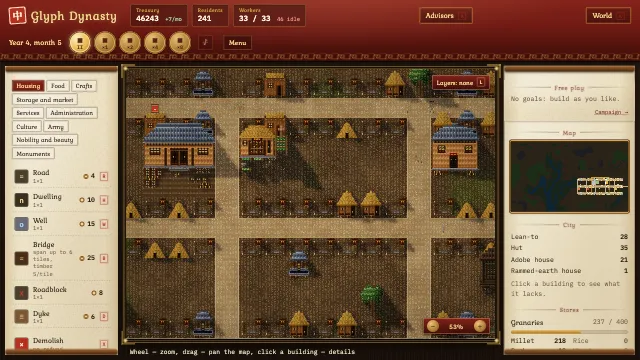
Ten steps in the first mission
The tutorial runs in the first Xia mission. Each step lights up the button you need and the spot on the map, and closes by itself as soon as the thing is done on the map; there is no Next button to press. Any step can be skipped, and so can the whole tutorial. Nothing about it is written into your save.
- A road from the high road. Settlers arrive along the high road from the edge of the map; until there is a road, time stands still
- Dwellings along the road. Four of them, with a counter: “Placed: 2 of 4”
- A well nearby. It supplies houses within 3 tiles and needs no road
- A millet field on the floodplain by the river
- A granary. Carters bring the harvest there; without one the millet is lost
- A market. It buys millet from the granary, and vendors carry it to the houses
- An ancestral shrine. A hut needs food and faith to become an adobe house, and the priest walks about 45 tiles
- A tax office. Only houses passed by a collector pay taxes
- Speed up time. The ×2 and ×4 buttons light up
- Why won’t this house grow? Click a house and read its card
Speed comes before the last step on purpose: at ×2 the settlers have time to move in, so there is a house worth clicking. If a building ends up without a road to the high road, or the well is too far from the houses, the tutorial points at that exact spot instead of asking for another one. When it is over, two tips remain: the mission goal, and how many workers the buildings you just placed need. The answer to a lack of hands is more streets of dwellings, not four houses.
The card that answers “why?”
Click any house and its card lists what the next level needs. Under each ✗ it now says what exactly is wrong for this particular house, worked out by the same rules the simulation uses for walkers:
- there is no well, or it is 5 tiles away and reaches only 3
- there is no shrine, market or healer yet
- there is one, but no road leads from it to this house, or a roadblock cuts the way
- it is too far: say, 60 steps by road, while its priest turns back after 45
- it has no workers, so no walker goes out
- the market has nothing to carry: there is no granary, or the granary is empty
- the city has fewer kinds of food than this level asks for
- an empty plot says it is waiting for settlers, instead of a misleading “the collector has not been here”
Each line has a Show button that moves the camera to the building in question. If everything is in place and the walker can reach the house, the card says that too: a visit is coming, because walkers wander the streets at random.
Players of the classics used to answer this question with forum threads and a lot of patience. We wrote about what Glyph Dynasty shares with Pharaoh and Caesar III in a separate article.
Found by a robot that plays badly
We played the first ten minutes of the first mission again and again in a headless browser and fixed what got in the way. On a 1280×800 screen the starting zoom showed only 8×9 tiles and the first street did not fit; now the game starts zoomed out until 12 tiles fit across. The “why won’t it grow” step used to arrive while the houses were still empty; now it waits for one with people in it. And when the whole city is short of workers, the first advice is now simply: build more houses.
All of this is in the Steam Next Fest demo, which is the first three Xia missions. If small text or red and green are a problem, see colour-blind colours and text size. How the walkers work is shown on the home page.
Glyph Dynasty is coming to Steam for Windows, macOS and Linux. Watch the clips, read about this in the development history and see this part of the game; for journalists there is a press kit.