Games like Pharaoh, Caesar III and Zeus: Master of Olympus
If you loved Caesar III or Pharaoh, you know the feeling: a market lady wandering the wrong way down a street, and a whole block of houses slipping a level. That style of city builder has a name, walker-based, and a small family of games. Here is a fair map of that family, and where Glyph Dynasty sits in it.
What a walker-based city builder is
In most city builders a building serves everything within a radius. In a walker-based one, services are people. A well sends out a water carrier, a temple a priest, a market a vendor, and each walks the roads, often choosing turns at random. A house gets what a walker brings past its door, and it evolves when everything for the next level arrives. Planning becomes a puzzle of loops, junctions and blocked streets.
The classics
- Caesar III (Impressions Games, 1998): the Roman city builder that defined the walker formula for many players, with housing that evolves step by step
- Pharaoh (Impressions Games, 1999) and its expansion Cleopatra: Queen of the Nile (2000): ancient Egypt, the Nile flood, monuments that take years
- Zeus: Master of Olympus (2000) and its expansion Poseidon (2001): ancient Greece, with heroes and gods
Impressions also took the formula to ancient China in 2002. All of these are still played today, and Caesar III even has open-source re-implementations made by fans.
Newer games in the same spirit
- Pharaoh: A New Era (Triskell Interactive, published by Dotemu, 2023): a remake of Pharaoh with new art and interface
- Nebuchadnezzar (Nepos Games, 2021): an isometric city builder set in ancient Mesopotamia, close to the classic production chains
Each of these is worth a look if you miss the genre. Glyph Dynasty is not trying to replace them; it is another branch of the same tree.
What Glyph Dynasty keeps
- Walkers: vendors, priests, healers, teachers and tax collectors walk the streets, and only houses the collector visited pay
- A housing ladder: ten levels of houses, plus six of the nobility
- Production chains, granaries and warehouses with orders per good, caravans and ships
- Monuments that take years, built stage by stage by haulers and builders
- A campaign that introduces mechanics one at a time
What it does differently
- Ancient China across five dynasties, from Xia to Han, with the words of each period
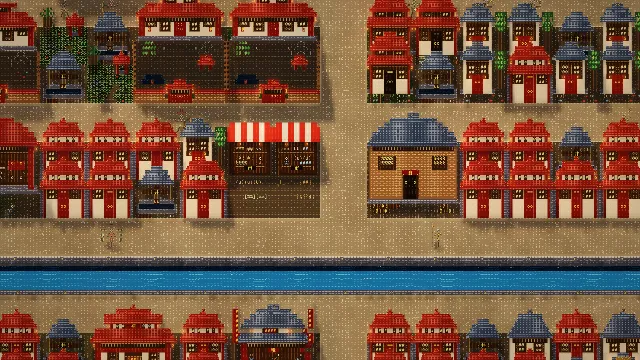
- The whole map is drawn in text characters, with real Chinese characters on 28 kinds of signboard
- Three ancestors who protect or punish the city by their element: fields, river and kilns
- Disasters you can see: floods, fires and locusts drawn as they happen
- A deterministic simulation, which makes co-op for 2–4 players possible, each in a city of their own
- Free play on maps up to 160×160 tiles, and five languages including Chinese
Who it is for
If you enjoy laying out a block so that one market vendor reaches every door, Glyph Dynasty is built for you. If you like ASCII art and text-based games, it is a city builder where the text is the point. And if ancient China is your interest, the campaign is a slow walk through two thousand years of it. The clips show what it looks like in motion.
Glyph Dynasty is coming to Steam for Windows, macOS and Linux. Watch the clips, follow the development history or open the press kit.