The Painted style: how we repainted our ink drawings with AI
Glyph Dynasty now has a third look, Painted: the same city, with buildings that look like painted concept art. It is optional. The glyph city stays the main look of the game, and Ink stays as the second. Since an image model was involved, here is exactly what it did and what it did not do.
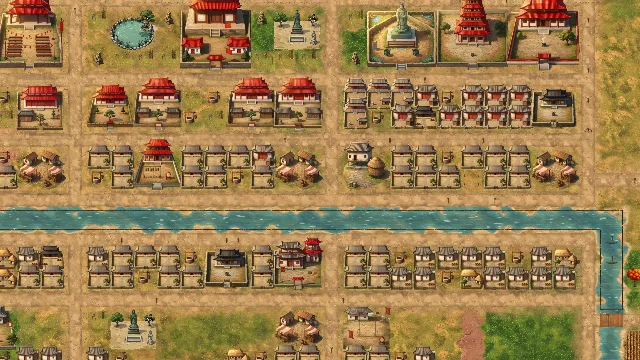
What is ours and what the model did
Every shape in Painted comes from us. The starting point for each building is its Ink drawing: the same footprint, halls, roofs, fences and details, rendered three times larger than in the game, 288 pixels per tile, on a plain light background. We call these skeletons. With each skeleton goes a short text description built from the same data: the epoch, the halls with their roofs and walls, the yard and the details.
The model only repaints. We used Qwen-Image-Edit, an open-weight image editing model, in a fast four-step setting on rented cloud GPUs. It never decides what a building looks like, where it stands or how large it is. Its job is the brushwork, the light and the materials.
The pipeline, step by step
- Skeleton: the ink drawing of the building for its kind, level, stage and epoch, on a plain background
- First pass: the skeleton beside a finished style sample, with the instruction to repaint only the sketch in the same manner while keeping its shape, footprint and camera angle
- Second pass: a richer painting of the result, again with strict rules: the same building, the same objects in the same places, no new roofs, no text
- Cutout: the plain background is removed from the edges inward, and the edge colour is cleaned so there is no light halo
- Alignment: the picture is fitted to the silhouette of the ink skeleton, so it stands on exactly the same tiles
- Rejection: if the silhouettes overlap by less than 70%, the picture is stretched or stray lettering appears, it is generated again with a new seed; after three tries the best one is kept and goes into a report for a person to check
- Baking: three sizes, so a picture is never stretched in the game
A building gets a picture of its own epoch only where its look really changes: the grey tiles of Zhou, the heavy dark roofs of Qin, the cinnabar of Han. That came to 71 pictures for Shang, 47 for Zhou, 54 for Qin, 48 for Han and 2 for Xia, which mostly shares its thatched look with Shang.
Where the model failed, and what we did instead
Walls, gates, the Great Wall, the Grand Canal and dykes join their neighbours in 16 ways, dykes in 256. The model would not keep a flat tile flat: it turned pieces of wall into diamonds, put them in perspective and painted a river and a sky behind them. So these are not generated at all. Their shape is the ink drawing, which already joins correctly at every corner, and the painting is a texture laid over it.
Fields are not pictures either, but part of the painted ground, which is blended from twelve seamless painted textures: grass, meadow, packed earth, clay, rock, forest floor, sand, ploughland, dirt road, paving, water and bridge planks. Trees are painted pictures, up to five per kind. Shadows, lit windows at night, fire, weather and the walkers all come from the ink layer underneath, so they line up with the picture.
The numbers
- About 330 generations in all, around 30 seconds each, counting retries and the failed experiments with fields and walls
- Roughly six dollars of GPU time
- About 8.5 MB of pictures, loaded only when you switch to Painted; the first download of the game does not grow
Why it is optional
Glyph Dynasty is a city drawn with text, and that is not going to change. Every building was drawn by hand in characters; that city is the default and the one in our clips. Painted is an experiment we found pretty enough to share: Settings → Graphics → Art style → painted. Like Ink, it changes only the look; your game and saves stay the same, and you can switch back at any moment.
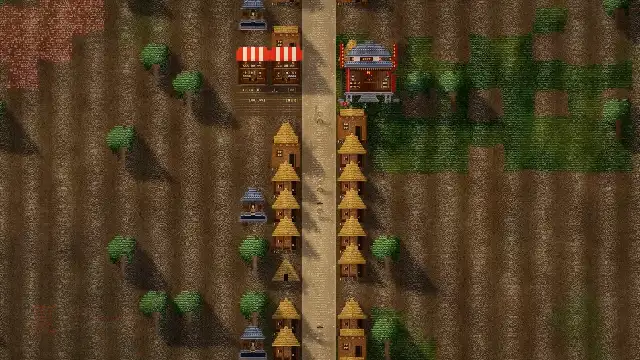
The glyph drawings themselves are explained in how we draw a whole city with text characters and from 10×5 to 16×8. The home page shows the city in motion.
Glyph Dynasty is coming to Steam for Windows, macOS and Linux. Watch the clips, read about this in the development history and see this part of the game; for journalists there is a press kit.