28 real Chinese characters on the signboards of the city
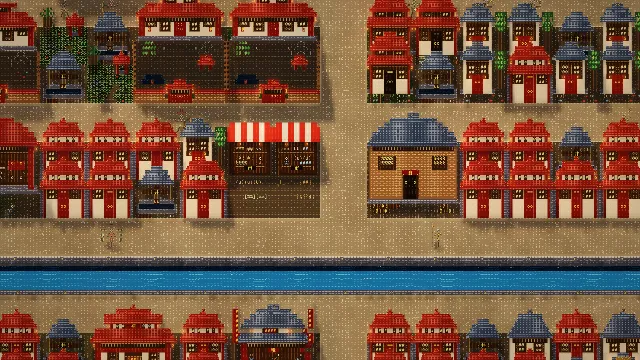
In a city drawn with text, the signboards had to be text too. Twenty-eight kinds of building in Glyph Dynasty carry real Chinese characters on their boards, in gold on black or red lacquer: 市 over the market, 倉 over the granary, 未央 over the Weiyang Palace. Here is the whole list, and what each sign means.
Why real characters
Glyph Dynasty is a city builder of ancient China drawn entirely with text characters, so a signboard was the obvious place for Chinese writing. These are not decorations made of random strokes: each board carries a real word that someone in a Qin or Han town could have read. The boards are only drawing; the game and your saves never see them. How the rest of the city is typed out is told in how we draw a whole city with text characters.
The signs use the full, traditional forms of the characters, the way they were written under the Qin and Han, not the simplified forms of modern mainland China. Monuments get their boards once they are finished.
All 28 signboards
- Market: 市 (shì), market, trade
- Ancestral shrine: 祠 (cí), a shrine to the ancestors and the spirits of the place
- Taoist temple: 廟 (miào), temple; 觀, the later word for a Taoist temple, belongs to the Tang
- Granary: 倉 (cāng), granary, state store of grain
- Warehouse: 庫 (kù), storehouse, a store under a roof
- Well: 井 (jǐng), well, on the windlass
- Confucian academy: 學 (xué), learning, school
- Taixue, hall and gate: 太學 (tàixué), the “Great School”, founded under the Han ruler Wudi in 124 BC
- Scribes’ school: 史 (shǐ), scribe, chronicler, the post the school trained for
- Library: 書 (shū), writing, books
- Ruler’s residence: 府 (fǔ), residence and office of a regional governor
- Tax office: 稅 (shuì), tax
- Herbalist: 藥 (yào), medicine
- Drum tower: 鼓 (gǔ), drum
- Office of Measures, Qin: 度量 (dùliàng), measures of length and volume, from 度量衡, the measures the Qin unified
- County tribunal, Qin: 縣 (xiàn), county; 衙, the later word for a government office, dates from the Tang
- Mint, Qin: 錢 (qián), money, coin
- State forge, Qin: 冶 (yě), to smelt metal
- Salt and Iron Office, Han: 鹽鐵 (yántiě), salt and iron, a state monopoly from 117 BC
- Western gate, Han, the tower: 關 (guān), frontier pass
- Western gate, the gates: 玉門 (Yùmén), the Jade Gate of the Yumenguan pass
- Weiyang Palace, the hall: 未央 (Wèiyāng), “never-ending”, the name of the palace
- Weiyang Palace, the gates: 宮 (gōng), palace
- Mausoleum of the First Sovereign: 陵 (líng), a royal burial mound
- Royal tomb: 墓 (mù), grave, on the stele
- Hall of Light: 明堂 (míngtáng), the “bright hall” of the rites
- Caravanserai: 驛 (yì), relay station of the post roads
- Infantry, crossbow and chariot camps: 營 (yíng), military camp
Readable at every zoom
Each character is drawn at the full height of a text row, edge to edge, in the middle of the board. At the default zoom on a high-density screen every sign can be read. On an ordinary screen a character is about nine pixels tall, so simple ones such as 市, 井, 倉 and 宮 read at once and complex ones such as 鹽鐵 or 縣 when you zoom in. Farther out a board fades smoothly into a patch of gold on lacquer. The letters of panels and windows can be enlarged on their own: see text size and colour-blind colours.
At the close 32×16 level a text row is half as tall, so the sign is laid over two rows and never gets smaller than at 16×8. More on that level in 32×16: the whole city drawn again.
A font of our own, under 14 KB
The characters come from our own subset of Noto Serif SC, a font under an open licence: only the characters the game needs, 13.6 KB in all. It loads together with the dense glyph style and is not part of the first download. The game never borrows a system Chinese font: until its own font arrives the board stays blank, so the signs look the same on every computer. The low graphics setting, which draws the older 10×5 tiles, has no signs.
The same font keeps a few spare characters for buildings still to come, among them 社 for an altar of the soil, 窯 for a kiln and 津 for a river crossing, and also 字里乾坤, the Chinese title of the game.
The history behind these buildings is in the five dynasties from Xia to Han and the Great Wall, the Grand Canal and the terracotta army. The signboards close up are on the home page.
Glyph Dynasty is coming to Steam for Windows, macOS and Linux. Watch the clips, read about this in the development history and see this part of the game; for journalists there is a press kit.